FHA Buyers Pull Back—Even as Rates Improve
New HUDPRO analysis reveals a market under affordability pressure
Analysis uses HUD FHA Single Family Forward purchase counts and MBA application survey references as cited.
Executive summary
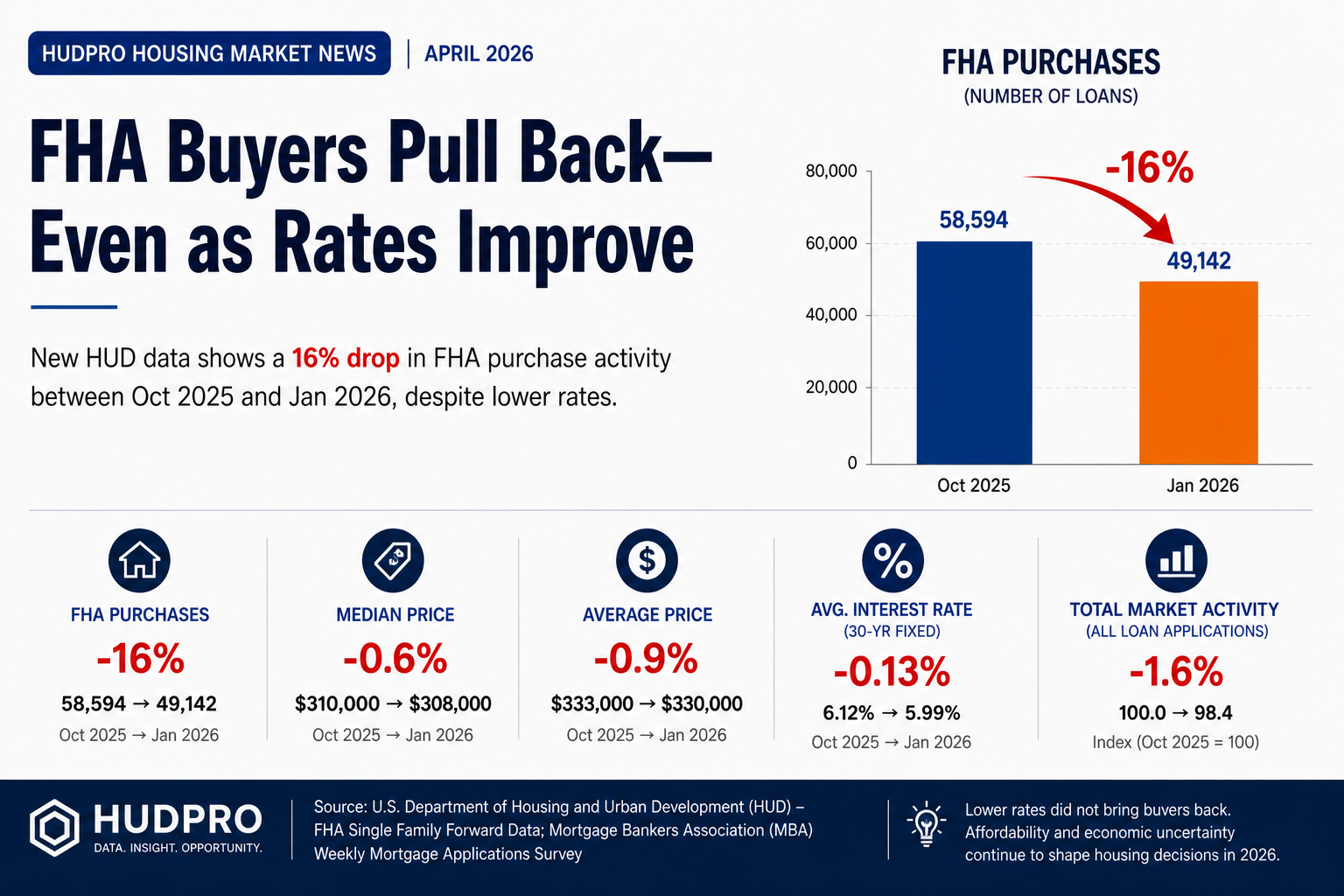
FHA purchase volume declined roughly 16% from October 2025 to January 2026.
Mortgage rates improved slightly, but demand still fell.
Buyer activity is contracting despite better financing conditions.
Market conditions are fragmenting across regions.
The Market Just Sent a Signal
Heading into 2026, the expectation was straightforward: if mortgage rates improved, buyers would return.
That's not what happened.
A HUDPRO analysis of federal housing data shows that FHA homebuyer activity declined significantly between late 2025 and early 2026—even as borrowing conditions improved.
- FHA purchase volume dropped ~16% nationwide
- Mortgage rates declined modestly
- Home prices softened—but only slightly
Buyers didn't come back. They stepped back.
The Numbers Tell the Story
From October 2025 to January 2026:
- Purchases: 58,594 → 49,142
- Median Price: ~$310K → ~$308K
- Average Price: ~$333K → ~$330K
- Rates: ~6.12% → ~5.99%
Lower rates alone did not unlock demand.
Instead, the data suggests that affordability constraints are outweighing modest improvements in financing conditions.
Where the Market Is Shifting
State-level data shows the market is not moving uniformly.
Fast Pullback Markets
- Montana: -39%
- Vermont: -33%
- Alaska: -32%
- North Dakota: -30%
- Nebraska: -27%
More Stable Markets
- New Jersey: ~flat
- Connecticut: slight dip
- New Mexico: slight increase
Mixed Price Signals
- Vermont: large price drop
- Montana: notable decline
- Massachusetts: prices still rising
The takeaway:
This is not a single market—it's a fragmented one.
Where FHA Fits in the Bigger Market
According to Mortgage Bankers Association data:
- Conventional: 67.3%
- FHA: 17.2%
- VA: 15.0%
- USDA: 0.5%
While FHA represents a minority of total mortgage volume, it plays an outsized role:
FHA is one of the clearest indicators of first-time and entry-level buyer demand.
The Affordability Lane Isn't Expanding
FHA buyers remain concentrated in a narrow range:
- Roughly $200K–$400K
- Median around $300K
That hasn't changed.
What has changed:
Fewer buyers are able to operate within that range.
Where Opportunity Is Emerging
When demand softens:
- Competition declines
- Listings sit longer
- Pricing inefficiencies appear
This is where HUD homes become particularly relevant:
- Often priced below retail
- Less competition
- FHA-compatible
Many fall directly within the affordability band buyers need.
The Real Takeaway
The housing market isn't rebounding—it's recalibrating.
Lower rates alone are not enough to bring buyers back.
Instead:
- Demand is thinning
- Buyers are constrained
- Markets are diverging
Final Thought
This isn't a frozen market—it's a selective one.
The advantage now goes to buyers and investors who understand where demand still exists—and where it's starting to fade.
Source: U.S. Department of Housing and Urban Development (HUD), FHA Single Family Forward data; Mortgage Bankers Association Weekly Applications Survey.
Housing professional with 23 years of experience in HUD-focused real estate and HUD-regulated housing workflows. About the author →
Take the next step
This article is HUDPRO editorial analysis. For external headlines, open Market News. By List is the live HUD inventory stats view; the map is where listings live.